
Electronics are increasingly central to system performance in automotive and high-tech applications. Components such as ECUs, ADAS cameras, and power electronics are often installed in confined spaces and exposed to rapidly changing thermal environments. Their thermal behavior is inherently transient, yet many evaluation methods still rely on steady-state assumptions or late-stage physical testing.
Transient thermal simulation enables engineers to evaluate how temperatures evolve over time in response to changing power loads, airflow, and environmental conditions. By capturing these time-dependent effects early in the design process, engineers can identify thermal risks that may not appear under steady-state analysis and make informed design decisions before hardware is built.
Why Transient Thermal Analysis Is Critical for Electronics
Electronic components experience dynamic thermal loading driven by operating modes, environmental exposure, and system-level interactions. Peak temperatures frequently occur during short-duration events such as cabin soak, startup, or transitions between operating states. These events may cause components to exceed their temperature limits even when steady-state temperatures appear acceptable. In high temperature conditions, components may decrease their power draw (i.e. derating) to prevent overheating and component failure. However, this behavior negatively impacts the performance of the electronics and can pose a risk to vehicle safety.
Transient analysis provides insight into heating and cooling rates, duration above critical temperature thresholds, and recovery time following high-temperature exposure. These factors directly influence reliability, derating behavior, and long-term performance.
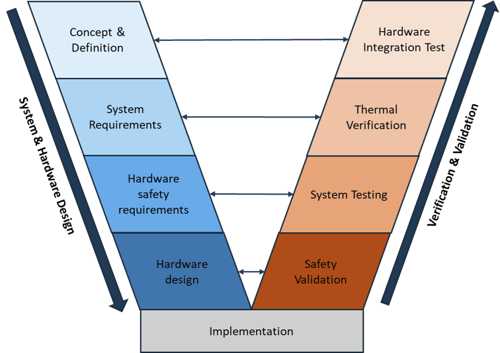
Electronics Thermal Modeling with TAITherm and RapidFlow
TAITherm provides a 3D thermal simulation environment capable of modeling conduction, convection, and radiation under transient conditions. Electronics components can be assigned time- and temperature-dependent power dissipation profiles, allowing simulations to reflect realistic operating and derating behavior rather than worst-case steady assumptions.
RapidFlow complements this capability by providing a fast, integrated 3D airflow solver. It captures transient convective effects without the computational overhead of traditional CFD, making it practical to evaluate airflow-driven cooling during soak, operation, and cooldown events.
Simulation Scenario
A full cabin model with an electronics control module (ECM) under the dash and an advanced driver assistance system (ADAS) camera near the rearview mirror is exposed to a hot cabin soak followed by an HVAC-driven cool down. During the soak phase, solar loading and elevated ambient temperatures caused cabin air and surrounding structures to heat up over time. The individual electronic components reach high temperatures.
When the car starts up during the cooldown phase, the electronics power on, generating more heat through their power dissipation. The transient analysis captures the temperature profiles of the electronic components, which can show whether they are operating out of their manufacturer-specified temperature limits or are derating their power.
Case Study 1: Transient Electronics Thermal Behavior Without Derating Behavior
The first case study evaluates the ECM and ADAS camera performance with a simple lumped capacitance electronics model and no derating behavior. Although the components are not actively dissipating power during the hot soak, their temperature continued to rise due to thermal inertia and heat transfer from the environment.
The transient results showed that peak component temperatures occurred well after the system entered a parked state. This behavior would not be captured by steady-state analysis, which assumes thermal equilibrium.
During the subsequent cooldown phase, airflow and convective heat transfer reduced component temperatures, but not uniformly. Some regions cooled rapidly due to direct airflow, while others retained heat for significantly longer periods. Important electronic components within the ECM and ADAS systems remained above their derating temperature thresholds, indicating that they must decrease power draw and performance so as not to overheat and fail entirely.
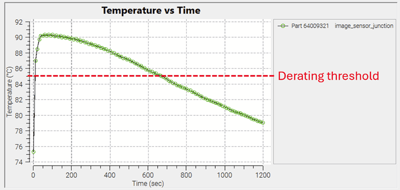
These results demonstrate that electronics power dissipation in extreme environments can result in components operating beyond their intended limits, making transient analysis essential for evaluating post-soak operability.
Case Study 2: Transient Thermal Simulation for ADAS Camera Design
The second case study focuses on the ADAS camera mounted near the windshield, where it is exposed to solar radiation, elevated ambient temperatures, and limited airflow. Transient simulation was used to evaluate how the camera housing and internal components responded to these conditions over time. The performance and derating behavior of two different CMOS image sensors were compared.
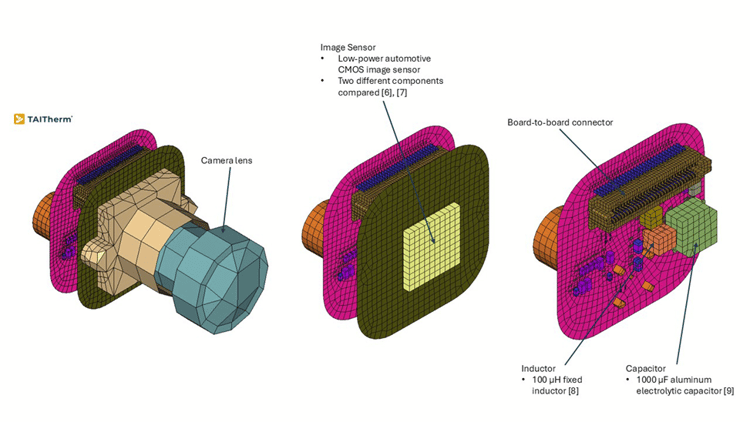
Results showed that camera temperatures increased significantly during environmental exposure, with peak temperatures occurring when the components turned on after the hot soak.
Both image sensors experienced derating due to high temperatures, but the second image sensor maintained a power draw closer to its typical 100% power load, performing better than the first image sensor because of its larger operating temperature range and lower typical power consumption.
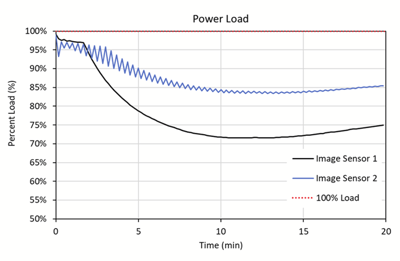
The analysis highlighted how placement in direct radiation, component choice, and airflow availability influence thermal response—critical factors for vision system reliability and overall vehicle safety.
Case Study 3: Impact of ECU Location on Transient Thermal Performance
The third case study examines how ECU placement under the dashboard affects transient thermal behavior. Multiple ECU locations were evaluated under identical operating and environmental conditions.
Transient results showed meaningful differences in heating rates, peak temperatures, and cooldown behavior based solely on location.
The ECU positioned closer to cool airflow paths near the HVAC recirc intake experienced lower peak temperatures and faster recovery, while more shielded locations near the top of the dash retained heat longer. These findings illustrate how transient simulation can guide architectural decisions early in vehicle design.
Linking Transient Results to Reliability and Design Decisions
Across all three case studies, transient simulation provided insight that steady-state analysis would not capture. Time-resolved temperature data enables engineers to evaluate exposure duration, recovery time, temperature cycling, and derating behavior, all of which influence component reliability and vehicle performance.
Conclusion
Fast transient thermal simulation using TAITherm and RapidFlow enables engineers to evaluate electronics performance under realistic operating conditions. By capturing time-dependent heat generation, airflow, and environmental effects, these tools provide a more complete understanding of electronics' thermal behavior and support better-informed design decisions earlier in development.
About the Author
 Savannah Page is a Thermal/CFD Engineer at ThermoAnalytics, where she supports the development and validation of automotive cabin and human thermal models. She specializes in modeling clothing, human thermoregulation, automotive HVAC systems, and medical device electronics, and she developed a Python tool that streamlines human model preprocessing. Savannah has presented her work at human thermal seminars and conferences worldwide. She earned her B.S. and M.S. degrees in Biomedical Engineering from Michigan Technological University before joining ThermoAnalytics in 2024.